A well-written product description has the power to move your customers through your sales funnel. By injecting creativity and product benefits into your product description, your store becomes more likely to convert the casual browser.
However, most entrepreneurs make a common mistake when writing product descriptions: including information that simply describes their item. This results in lower conversions as people are unable to understand the unique value proposition of a product or how it offers a solution to a frustrating problem.
In this article, you’ll learn how to write product descriptions that sell and find a product description writer, learn from product description examples, and we’ll introduce an easy-to follow product description template.
What is a product description?
A product description is the copy that describes the features and benefits of a product to a customer. The goal of the product description is to provide the customer with enough information to compel them to want to buy the product immediately.
To master product description writing, you need to learn how to write persuasive copy for your products. Plus, you need to answer every question a customer may have, such as:
- What problem does your product solve?
- What do I gain from using your product?
- What separates your products from others on the market?
Your brief description needs to answer these questions in a way that is easy to read.

How to write product descriptions that sell
1. Write your own
Avoid using the manufacturer’s product descriptions. By writing your own copy, you avoid being penalized by Google for duplicate or thin content. Plus, you improve your chances of writing a product description that converts your customer.
2. Make it scannable
Your product description should be easy to read. Having two sentences describing the product with several bullet points allows customers to receive the information quickly so they can purchase immediately. If you sell laptops, you’ll want to turn the specs into bullet points for an easy read.
3. Know your audience
If you sell fun products like ugly christmas sweaters or food shaped jewelry you could inject humor into it. Your copy should be playful and light as customers buying those types of products would likely appreciate an entertaining product description. However, humor doesn’t work on all dropshipping niches. For example, you wouldn’t want to inject humor into a product description about life jackets, coffins, or other sensitive issues.
4. Optimize your product descriptions
The easiest way to optimize your product summary is to use a tool like Plug in SEO on your store. You’ll want to use keywords that are relevant to your product. For example, if you sell makeup brushes, you’ll want to be specific such as ‘unicorn makeup brush’ or ‘mermaid makeup brush.’
5. Tell a story
Use your product description to tell a story. It could be the story of why your customer needs this product to solve their problem. Or a story of the product's benefits. Or just an entertaining story about the product that draws your customer in.
6. Split test it
Don’t forget to split test your product descriptions. Test different formats, lengths, words, and more. Split testing your product descriptions can help you optimize your product page to improve your conversion rate.
7. Spell check your work
Read over your product descriptions to ensure there are no typos. You can use tools like Grammarly to avoid spelling mistakes.
8. Offer all the details
Make sure that customers have the information they need to make a purchase. For example, if dropshipping apparel, care information and size charts can help customers before and after their purchase. If you sell tablets, you’ll want to ensure you list all the specs. If you dropship jewelry, you’ll want to include information such as ‘nickel free’, as some may have allergies to certain materials.
Split testing whether you need product descriptions
It depends. Like every other aspect of your website, product descriptions may or may not be needed. It needs to be split tested. Each website has a different layout, personality, and style which may require a different product description template.
Some stores may convert best with only bullet point descriptions. Others may need a long paragraph, or a mix of bullet points and a paragraph. And some websites may convert best with no copy at all. You can use A/B split tests to determine what format works best for you.
Here’s a product description example with no copy. According to VWO, an online store called FreestyleXtreme ran a split test. Their test included two landing pages – one with and another without a product description. They were surprised when they found out that the page without copy converted 31.88% better and had a 96% confidence level.

There are several factors as to why the product descriptions didn’t convert well. It’s possible they weren’t written correctly for the audience, they were placed in a less visible area, or were written in the wrong format. However, when it comes to your specific store, testing whether or not you should have product descriptions, in the first place, can help you better understand how to optimize future product pages.
Benefits of writing product descriptions
Having optimized product details can help improve your search engine optimization (SEO). By optimizing your item description to include specific keywords, you can help improve your chances of ranking high on Google. Without product descriptions, you may be able to optimize your images for keywords, but your product page may not appear high in search results due to a lack of content.
Product descriptions can also educate your customer on the product. The product description offers supplemental product information that the picture can’t do on its own. For example, you likely wouldn’t buy a laptop by looking at the picture alone. As a shopper, you’d want to read about the laptop’s specifications and features. This also applies to fashion — some people may be allergic to certain fabrics and need to know the material of the clothing you sell on your store. By providing customers with key product information, you prevent a build up of customer service inquiries. It also helps customers know if that specific product is right for them, which can help lower return rates.
A product description can also be used to make a customer laugh to enhance the bond between your brand and customer. It can also assure customers that your product will solve their biggest pain point or enhance their life in some way.
Picking the right words for your product description

According to David Ogilvy, the 20 most influential words include:
- Suddenly
- Now
- Announcing
- Introducing
- Amazing
- Sensational
- Revolutionary
- Miracle
- Magic
- Quick
- Hurry
- and more.
Using the keywords listed above can help captivate your reader and persuade them into action. You can use these words in product descriptions, headlines, email templates, and more.
According to Unbounce, there are also several words and phrases that people shouldn’t be using in their copy, product description, and more.
Poor word choices include:
- Market-leading
- Breakthrough
- Innovative
- Stunning
- Ultimate
- and more.
Ultimately, the words are poor choices if they aren’t accurate. Calling your product revolutionary when it’s not isn’t going to make your brand stand out.
Honesty and tone in product descriptions
It’s important that your product overview includes honest and transparent information. Saying a product is free when it really isn’t is deceptive. Saying your product is of the highest quality when you have countless complaints about the product quality isn’t going to trick people into liking your product.
For example, if several people notice that the material is thinner than expected, you can mention that in your copy without drastically impacting sales. It gives your customers an honest expectation of the product before they receive it. Your customers may even prefer thinner fabrics on summer days.
Being honest doesn’t mean writing all of your products flaws but highlighting its strengths. Is the design what’s selling the product? Put an emphasis on the look of the product when describing it.
You’ll also want to bring your customer into the product description using words like you. Help your customers envision themselves using your product. Make them part of your product’s story.
Keeping it casual can also help your product description stand out. You’re not writing a thesis, but an enticing description to bring your product and your customer together. Use contractions in your writing like you’re, you’d, who’d, etc.
Product description examples from ModCloth to Naked Wines
1. ModCloth

ModCloth is a great product description example to learn from. The product description is short and sweet with only two sentences. The product details include scannable bullet points. The first sentence of the product description compliments the customer by mentioning their ‘glimmering charisma.’ However, the customer compliment is tied into the ‘glorious glimmering’ of the bolero. The second sentence compliments the customer again in relation to the product. Pay close attention to the language used in the copy. Words like ‘delighted,’ ‘delicate,’ ‘magnificence,’ ‘radiance,’ ‘gloriously’, and ‘glimmers’ are used to capture attention while being positive descriptors.
2. Tipsy Elves

Tipsy Elves is an excellent product description example of showcasing the product benefits. Their short and sweet two sentence description mentions that this jumpsuit is perfect for ‘lazy days on the couch, USA events, and hitting the slopes.’ For those looking for an outfit for the 4th of July, their problem is solved as it mentions that this outfit is ideal for it. Notice how the first word in the copy is ‘freedom’, which is a positive word and is often associated with American pride products. Their product details aren’t very scannable. However, they mention the benefits for some of their features such as mentioning that the material is thinner for ‘year round wear.’
3. Chubbies

Chubbies is a great product description example for creativity. The shorts shown in the picture above are called ‘The Mojitos’ likely due to its minty green color. Their opening description runs with the mojito theme though their product picture fails to show a mojito which would likely blend pretty nicely. They mention benefits with their product features such as ‘keep you oh-so comfortable.’
4. Naked Wines

Naked Wines keep their product description scannable with three bulleted points. Their bullet points creatively use check marks which helps customers make a positive association with the wine. The writing style is casual with phrases like ‘who’da thought it…’ They also build brand trust by mentioning that ‘91% of you would happily buy it again!’ Pay close attention to the language used to describe the wine such as ‘ripe’, ‘peppery undertones’, ‘lashings of oak’, ‘scrumptious’, and ‘silky finish.’
Product description template
There are countless methods on how to write product descriptions. If you’re ever stuck on a format you can follow this simple product description template while writing your copy.
3-step product description template
- Complement the customer in relation to the product.
- Mention the product benefit in relation to the product feature.
- Provide a simple recommendation.
For example, if you’re selling unicorn brushes you might try this product description example:
Like this unicorn brush, you’re one of a kind. These brushes are made with synthetic bristles for an easy clean. Pair this set with our mermaid brushes for a complete set of unique makeup brushes.
If you’re selling a dress, you might follow this product description example:
Nothing will flatter your curves better than this bootylicious evening dress. Made of a stretchy spandex, this dress will hug your body on all the right spots while highlighting your silhouette. With a simple pair of black pumps, you’ll complete your look to help you look flawless.
How to find a product description writer
Struggling to figure out how to write product descriptions that sell? If English isn’t your first language, you might want to hire a product description writer.
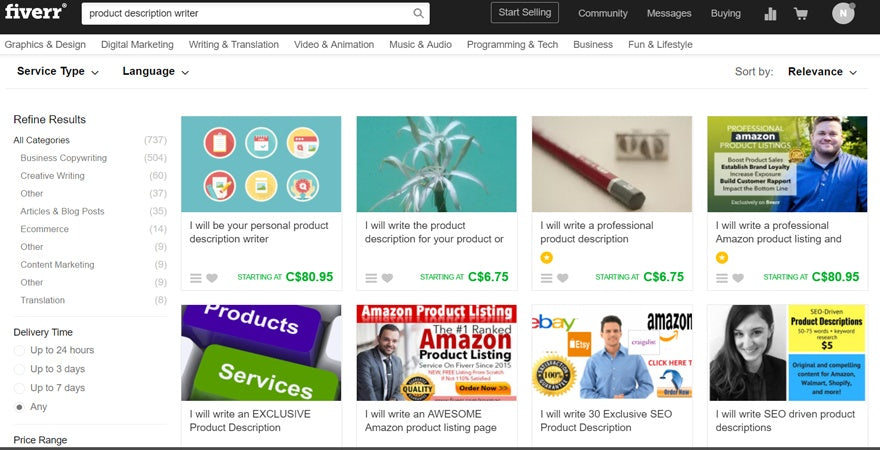
Finding a great writer requires patience. You can use sites like ProBlogger, Fiverr, or Guru to find quality product description writers. Look at a writer’s reviews, previous work, and who they’ve worked for in the past to determine the quality of their product description writing.
Summary: steps for writing a great product description
Mastering your product descriptions will require creativity and testing. Don’t be afraid to test our product description template to help you improve your format. Writing product descriptions that sell takes a bit of experimentation but with some patience you could end up in this article one day as a product description example.
In summary, here are the steps involved in writing a great product description:
- Write an original description.
- Ensure your product description is scannable.
- Match the copy to your audience.
- Optimize your product description.
- Tell a story about the product.
- Split test your product copy.
- Spell check your product description.
- Include the fine details like product specs and measurements.
Do you have any tips on writing product descriptions? Do you A/B test your descriptions? Let us know in the comments below.
Related reading on product pages and ecommerce
- How to Create a Great Product Page
- How to Brand Your Ecommerce Business in Five Easy Steps
- How to Get a Product Review That Converts Customers
- 15 Product Photography Tips That’ll Make You More Money
- Ecommerce Roadmap: How to Start Ecommerce Business That Will Succeed
Is there anything else you’d like to know more about and wish was included in this article?
Product Descriptions FAQ
How long should a product description be?
There's no fixed length, because the right format depends on your store's layout, personality, and style. Some stores convert with only bullet points, others with a long paragraph or a mix of both. Many strong examples use two short sentences plus scannable bullets. Run A/B split tests on length and format to see what works for your audience.
Can a product page convert without a product description?
Yes, a product page can convert without a description. In one split test, the landing page with no copy converted 31.88% better than the version with copy, at a 96% confidence level. Possible causes include copy that didn't suit the audience, poor placement, or the wrong format. Test your own pages with and without copy before deciding.
Should a product description mention product flaws?
You can mention a known drawback honestly without drastically impacting sales, as long as the copy still highlights the product's strengths. If several buyers say a fabric is thinner than expected, say so. Customers get a realistic expectation before delivery, and some may even prefer thinner fabric on summer days.
What tone should I use in a product description?
Use a casual, conversational tone that speaks directly to the customer with words like "you." Contractions such as you're and you'd keep the copy relaxed. Match humor to the audience: playful works for fun products like novelty sweaters, but skip it for sensitive items such as life jackets or coffins.
How do product descriptions reduce returns and support questions?
Clear product details help customers decide whether an item suits them, which can lower return rates and head off customer service inquiries. Laptop specs, fabric material for shoppers with allergies, and size charts or care instructions for apparel answer common questions before buyers need to ask.